How AI is Revolutionizing Sales Teams Daily Workflow
The Sales Process hasn’t changed.
Find the right prospects. Reach out to them. Follow up.
This process has existed forever.
Every seller knows it, every team follows it.
It is the backbone of all commercial activity, regardless of the sector, regardless of the size of the team.
However, the sellers themselves are drowning between the number of tools to master, the data to juggle, the tasks to manage between two calls.
And somewhere in all that, the seller’s true mission — selling — is not executed as it should be.
Here’s how it really happens.
Step 1: Finding prospects
Before picking up the phone or sending a message, the seller needs to know who to talk to.
Not just a list of names — the right people, in the right companies, at the right time.
This is a critical step.
A poorly targeted prospect is time wasted all the way down the line: a call that doesn’t convert, a pipeline that fills up but generates nothing.
The quality of prospecting largely determines the quality of the deals that follow.
Three tools dominate this step.
Clay
Clay is a data enrichment platform that aggregates information from more than 100 different sources — LinkedIn, B2B databases, intent signals, job boards, and many others.
Concretely, instead of spending hours manually researching information on each prospect, Clay automates this groundwork.
It builds enriched lists for you with the data that matters: position, company size, recent growth signals, technologies used, and more.
What makes it really powerful for a seller is the "waterfall enrichment": Clay queries the sources one after the other until it finds the right data.
If Apollo doesn’t find the email, it tries Hunter, then another source automatically.
It allows maximum data coverage without paying for redundant subscriptions, and above all without wasting time manually verifying.
The seller ends up with a qualified, enriched prospect list, ready to be worked. They can score leads according to their own ICP criteria and focus their energy on those with the highest chance of converting.
Apollo.io
Apollo.io goes further by combining a database of 275M+ contacts with built-in engagement tools.
This is its real strength for sales teams: the seller doesn’t need to switch between multiple tools to find a prospect, verify their details, then launch a prospecting sequence. Everything happens in the same interface.
In the daily workflow, it looks like this:
the seller identifies a segment of prospects matching their ICP, filters by industry, company size, intent signals, sets up an automated email sequence with multiple touchpoints, and lets Apollo handle the follow-ups. They receive alerts when a prospect interacts with their emails, which allows them to prioritize their efforts at the right moment.
For teams that need to prospect at volume while maintaining a personalized approach, this is a central tool.
LinkedIn Sales Navigator
LinkedIn Sales Navigator operates on a different ground: the professional network.
With more than 1 billion professionals on LinkedIn, Sales Navigator gives access to a depth of information impossible to find elsewhere — professional background, recent activity, common connections, job change signals.
What it concretely changes for the seller:
they can identify exactly the right decision-maker in a target company, see if they recently changed positions (strong signal of openness to new solutions), spot common connections to request an introduction, and personalize their approach with precise elements from the profile.
InMails allow direct contact with prospects outside the network with much higher response rates than cold emails.
It’s the tool that transforms a cold approach into a contextualized approach.
These three tools form the basis of solid prospecting.
But finding the right prospects is only the first part of the job. Then comes the moment when everything really plays out.
Step 2: Reaching out and closing — the call
This is the moment when the seller is face to face with the prospect.
No matter how they got this call — cold email, InMail, contact intro — what matters now is what happens in the next few minutes.
It’s a high-precision exercise.
The seller must actively listen to the client, understand them, respond to their problems and overcome their potential objections and doubts — in real time, while maintaining a fluid conversation.
Some take important information notes during the calls directly, others memorize and reconstruct afterward or review the call later for that (if they were able to record it). Everyone has their method.
But whatever the approach, the objective remains the same: keep enough context to close, without losing the thread of the conversation.
Step 3: The post-call follow-up
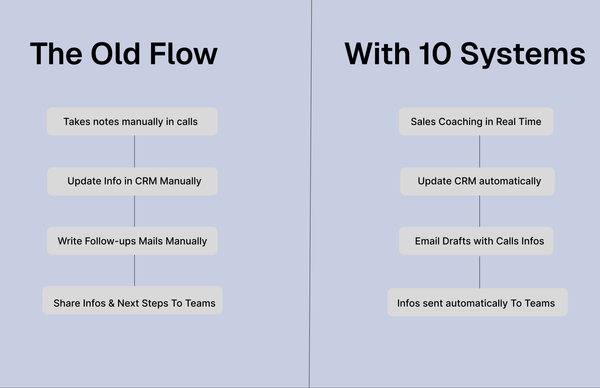
The call is over. The prospect has hung up. And now the real administrative work begins.
The seller must update the client’s information in the CRM, write and send a follow-up email, share a summary with their team, define the next steps, and if possible re-listen to the call recording to not miss anything.
Sales Teams generally use tools like Hubspot and Slack in this phase.
Hubspot
Concretely, it’s where all the client data lives: complete history of exchanges, sent and opened emails, call notes, deal stages in the pipeline. For a seller, HubSpot is the external memory of their commercial activity.
Without it, information on each prospect is scattered between their email inbox, personal notes, and memory.
What HubSpot really brings to the workflow is continuity.
When a deal moves from one stage to another, the CRM automatically triggers the right sequences: follow-up email, assigned follow-up task, notification to a manager.
The visual pipeline allows you to see at a glance where each deal stands, which prospects haven’t been contacted for too long, and where to focus efforts. For a manager, it’s also the reporting tool that helps understand what’s working in the team and what’s blocking.
Slack
Slack plays a different but equally central role in the post-call workflow.
This is where the seller shares their summaries with the team, or asks for information from another department before following up with a prospect.
In many teams, Slack is the coordination thread that ensures nothing falls through the cracks — that the person taking over a deal knows exactly where it stands, that the manager is informed of important signals, that the next steps are shared and assigned.
Conclusion on the process
This process is used by every seller, in every industry. It works really well. The tools are solid, the steps are clear, and most importantly, it has been delivering results for a long time.
However, it has a major hidden cost.
The problem is that all of this remains manual.
The seller writes the summary themselves, copies the information into HubSpot, writes the Slack message, composes the follow-up email from scratch. With every call, the same cycle of tasks starts over.
Valuable prospect information — pain points, objections, buying signals — is scattered across tools. And every transition between tools costs time, information, energy, and most importantly, money. Sellers spend a significant portion of their time on tasks that aren't selling.
Every minute spent updating the CRM, writing a summary, reconstructing context is a minute less for building a relationship and closing a deal.
That's exactly the problem 10Systems solves.
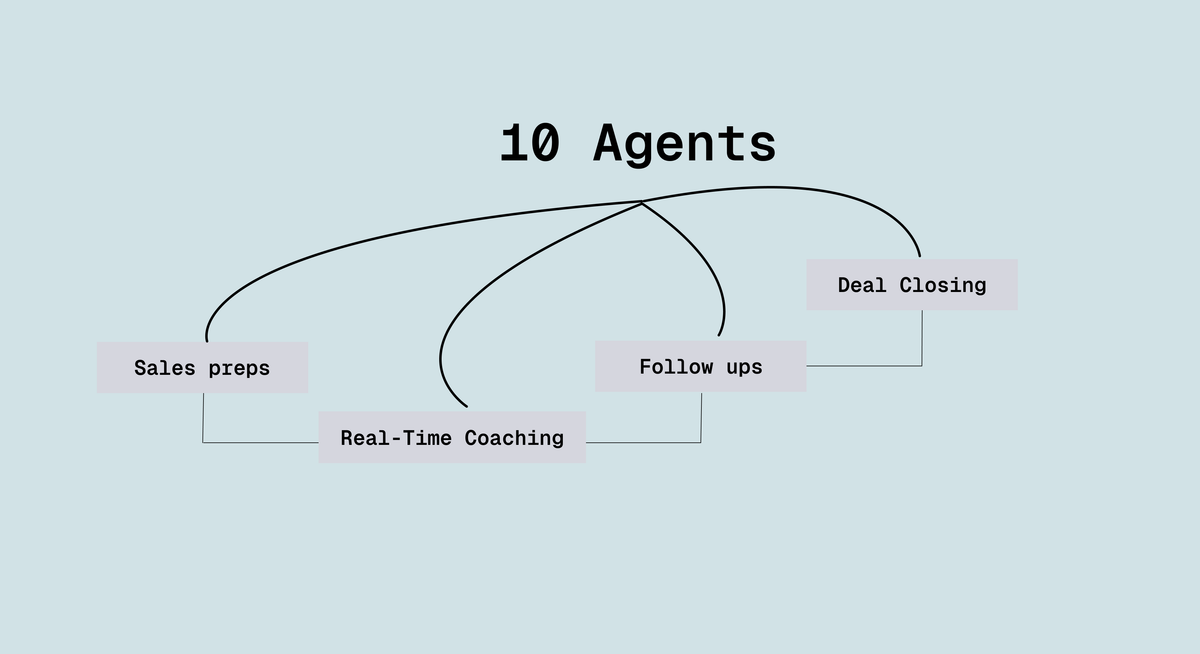
10 Agent – the agent that gives sellers the weapons to close more
The temptation, when seeing a problem is to add a new tool.
But that’s not what sellers need. They already have too many tools to manage.
What they need is for their tools to work together — and to have the right information at the right moment, without having to search for it.
This is exactly what 10 Agent does.
It connects to your existing stack — Clay, Apollo, LinkedIn, HubSpot, Slack — and creates an intelligent layer that centralizes context, eliminates low-value tasks, and arms the seller at every step of the process.
#Before the call
10 Agent gathers everything that exists on the prospect in your current tools and presents it in a clear and actionable way.
Clay enrichment data, HubSpot history, email exchanges, LinkedIn signals — no more navigating between five tabs to reconstruct the context.
Everything is there, centralized, in a few seconds.
Based on the prospect’s profile and the call objective, it also prepares a complete brief with the likely pain points to address. The seller enters the call prepared, confident, with a clear overview of their prospect.
What 10 Agent can do:
"Find our most qualified customers and summarize key infos about them"
"What are the key infos I can use to close the deal with customer XY?"
You ask for the information you want and it brings it to you in a few seconds.
#During the call
10 Agent records the call and offers sellers real-time sales coaching.
Based on the prospect’s information, the desired outcome and the script, it surfaces the right questions and suggestions at the right moment without interrupting the flow of the conversation.
If the prospect raises an objection, 10 Agent suggests an angle of response.
If a signal of interest appears in the conversation, it surfaces the most relevant arguments to capitalize on it.
The seller stays focused on the relationship — 10 Agent handles the support in the background.
#After the call
No more manual tasks. No need to spend twenty minutes writing a summary, updating the CRM, writing the follow-up and making a brief for the team on Slack.
You simply describe what you want to the agent, and it takes care of it:
"Summarize this call and send it to our Slack channel"
"Based on the call, write a follow-up email addressing the customer's main pain points"
"Update this contact's information and deal stage in HubSpot"
"What are the key points I can use to close this deal?"
In a few seconds, everything is processed.
The data is in the CRM, the team is briefed, the follow-up is ready.
The seller can already think about the next call.
And the most interesting thing in all this is that every call makes 10 Agent smarter.
It learns from your conversations, refines its suggestions, better understands your style, your prospects, and your deals — and becomes capable of executing increasingly complex tasks with growing precision.
The sales process doesn’t need to be reinvented.
It needs to be lightened.
Sellers have a mission: build relationships and close deals.
10 Agent sets everything up so they can focus solely on that — and takes care of the rest.